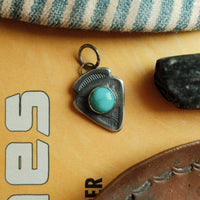
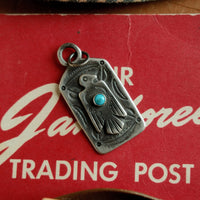
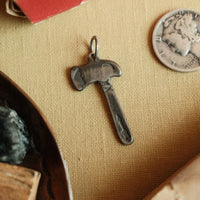
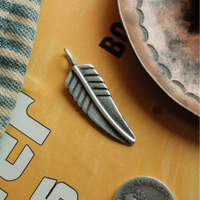
Tufa Casting — An American Tradition
Pick up a tufa cast piece and you'll feel it before you see it: a faint, stony grain pressed into the silver itself. That texture isn't a finish we apply. It's the signature of one of the oldest ways of casting silver in the American Southwest — and one of the few techniques in modern jewelry making that has barely changed in over 150 years.
What Is Tufa Casting?
Tufa is volcanic ash that settled and compressed over time into a soft, light stone. It's soft enough to carve with simple hand tools, porous enough to let hot gases escape, and yet it withstands the shock of molten silver at well over 1,600°F. In tufa casting, the silversmith cuts a block of tufa in half, grinds the faces flat, and carves the design directly into the stone — in reverse. The two halves are bound back together, a channel is cut for the pour, and molten silver is ladled straight into the mold.
There is no wax model, no machine, and no production line. The mold itself is the artwork, and the stone gives some of itself to every pour.
A Craft Born of Trade
Tufa casting is collaborative in its origin. In the mid-to-late 1800s, Spanish and Mexican smiths taught metalworking to the Indians of the Southwest — by most accounts in exchange for livestock. The earliest casts were poured from melted-down silver coins, American and Mexican alike, transformed over a fire into the ketohs, najas, buckles, and bracelets that collectors still prize today.
From that exchange — a tradition carried hand to hand, teacher to apprentice, for over a century and a half.
How a Tufa Cast Piece Is Made
- Cut and true the stone. A block of tufa is sawn in half and the faces are ground perfectly flat against each other.
- Carve the design — backwards. The piece is carved into one face as a mirror image, working in negative: everything cut away becomes silver.
- Cut the sprue and vents. A funnel-shaped channel carries the pour; fine vent lines let air and gases escape ahead of the metal.
- Bind and pour. The halves are clamped or tied together and molten silver is poured in a single, committed motion. There are no second chances mid-pour.
- Break out and finish. Once cooled, the casting is freed, the sprue is cut away, and the piece is filed, shaped, and finished by hand — often with turquoise set last.
A tufa mold is a consumable thing. The detail softens a little with every pour, and many molds give only a handful of castings — some only one — before the carving is spent. When the mold is done, that design is done.
Like a Fingerprint
Each piece made with tufa inherits a natural texture and grit from the stone — like a fingerprint, unrepeatable from cast to cast. That surface can be easily filed and polished away, but we think preserving it gives each piece its own story: married to the earth from which all of these materials originally came.
Tufa Casting vs. Sand Casting
The two are often confused, and they're related — both pour silver into a hand-made mold. But sand casting packs fine sand around an existing pattern, so the same pattern can produce mold after mold. Tufa casting has no pattern at all: the design exists only as a carving in the stone, the mold wears out, and the texture of the ash is printed into the metal. Sand casting copies. Tufa casting originates.
A Tradition Few Still Practice
Though tufa casting has a rich history in Southwest jewelry making, only a few silversmiths still work this way. It's slow. Pours fail. Molds crack. Every step rides on hand skill that takes years to earn. Modern lost-wax casting is faster, cheaper, and endlessly repeatable — which is exactly why it can't do what tufa does. We keep casting in stone because preserving tradition isn't a slogan to us; it's the work.
Tufa Casting at The Common Company
You'll find tufa cast work throughout our catalog, noted in the description of each piece made this way. When you wear one, you're wearing a small run of silver — sometimes a run of exactly one — poured through a method older than the state it was made in.
Common Questions About Tufa Casting
-
Why does tufa cast jewelry have a rough texture?
The texture is the surface of the volcanic ash stone itself, transferred to the silver during the pour. It can be polished off, but most traditional smiths — ourselves included — leave it as the mark of the method.
-
Is every tufa cast piece one of a kind?
Effectively, yes. Even when a mold survives more than one pour, each casting picks up its own variation in texture and detail, and every mold has a short life. No two finished pieces are identical.
-
Is tufa cast silver durable?
Yes — it's solid sterling or coin-weight silver, the same metal as fabricated jewelry. The casting method changes the character of the surface, not the strength of the piece.